
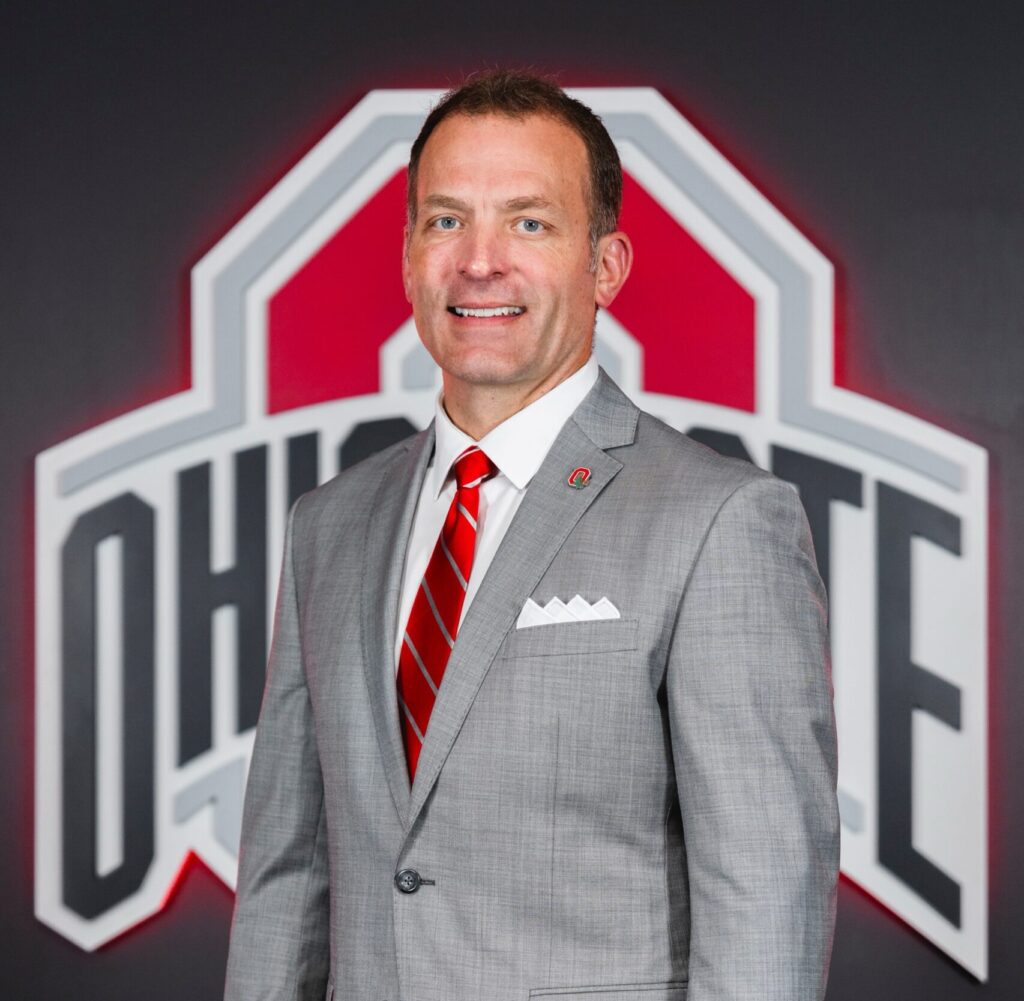
Last week, I sat down with Ross Bjork, Director of Athletics at The Ohio State University. With 36 varsity sports under his leadership, Ross has a front-row seat to everything from championship runs to the evolving business of college athletics. We talked about the programs that deserve more attention, creating a true home-field advantage and the future student-athlete model.
Be sure to sign up for our newsletter so you don’t miss our next interview.

Of the 36 sports at The Ohio State University, what do you think is the most underappreciated?
It’s so hard to pick one. But even though they’ve won national championships in the last four years, I would probably say our women’s ice hockey program. We don’t play in the Big Ten Conference. We play in the WCHA (Western Collegiate Hockey Association), which is a hockey-only conference, so it kind of flies under the radar. But if you really boil it down in terms of structure, leadership, intensity, doing it the right way, Coach Nadine Muzerall is just at the top of the game in terms of coaching and leadership. So, it’s a lot of fun to watch them. I love going to the games because it is in a small venue, and you’re sort of right on top of the action.
Aren’t five of those hockey players at the Olympics right now?
There are five Olympians from our team now – one USA, one Finland, and three Sweden. And then there are another seven former Ohio State hockey players, so we have 12 representing our women’s hockey program at the Olympics right now. And there’s not a break. We just played Wisconsin this past weekend, and they were down five players and we were down five players.
Do you think you’ve achieved your goal of creating a louder, more hostile environment at Ohio Stadium and the Schottenstein Center?
No, because you’re never done. In football, I think we accomplished what we were trying to achieve, and that is no downtime, energy constantly. With basketball, it’s a harder equation. One, the building is so big. As much as we try to sell tickets and fill it, we’re in that 10,000-to-12,000 range of capacity for attendance. But we did change the music. We did change the lighting. We changed the court. So, I do think we’ve done a few things, but now we’ve just got to get the product better, and when the product’s better, the atmosphere can be better. But if you go to any event in the Covelli Center — wrestling, gymnastics, volleyball — you’re going to walk away from there entertained, because everybody’s on top of the action.
How is the fan culture at Ohio State different from when you were at A&M?
Both places have great fan bases. It feels like here at Ohio State, you don’t necessarily have to have a connection directly to Ohio State, to be a fan. If you grew up in Ohio, you now live in Ohio, or let’s say your parents grew up in Ohio, but they moved away, and you grew up in California — you’re still a Buckeye fan. You’re connected somehow. Whereas, at A&M, you probably have to have some direct connection to really be a fan. Now they have a huge alumni base, a huge student body, but it feels like you have to have some direct connection. And at Texas A&M, you have to compete against the University of Texas. Like it or not, they’re a competitor. They have a huge brand. There’s a big footprint. There’s probably more of what I would call sidewalk fans of University of Texas than there were of Texas A&M. Here in Ohio, everybody’s a Buckeye fan.
Is there an unexpected sport at Ohio State that’s on the rise because of NIL (Name, Image and Likeness)?
I look at men’s lacrosse, who have really capitalized in this sort of new NIL era because Coach Nick Myers has gone out and developed relationships, and now in the business community and donor community. There’s just a really cool vibe around that program. There’s not necessarily one donor. There’s a group of people that have said they want to support men’s lacrosse. So last year, they were Big Ten champs in the regular season. We hosted an NCAA game. We didn’t get out of the first round, but we were a top seed in the tournament. Wrestling also has done a really good job. Coach Tom Ryan has unbelievable relationships in this town in the wrestling community. And our women’s basketball team has done really good, especially in marketing agreements and having the athletes promote companies and things like that. So, I look at those three sports that have done a really good job.
Where do you stand on athlete unionization?
What we all want is a legally defensible college athletic model. There was a 2021 Supreme Court case, NCAA versus Alston, that allowed us to pay academic award money of around $6,000 a year. But the opinion written by Justice Kavanaugh basically just blistered college athletics and said, if you don’t get your house in order, then either the courts will continue to take over, Congress will take over, or it will just go away because you’re violating the law. So, to me, the only way to safeguard a legally defensible model is you have to sit down with the athletes, and you have to negotiate the terms of their financial arrangement between the school, university and the athlete. That’s the only way to safeguard a legal liability protection. So, is it unionization? Yeah. In a broad sense, in some ways it is. They may not have to join a union per se, but there’s got to be some agreement that we reach with the athletes. Otherwise, we’re going to be in a vicious cycle. We’re going to have continued state-by-state law; we’re going to have continued court case battles; we’re going to continue to probably be on the wrong side of it.
So, if you didn’t work in athletics, where else at Ohio State would you love to work?
I would work at the OSU golf course. I would be on the grounds crew. I would love mowing the fairways and the greens, like the way they do the striping. I think that’s very satisfying. In my last year in high school and then early in college, I worked at a golf course. And I thought about becoming a golf course superintendent because you’re outside, you’re dealing with a little science and chemicals, and you’re also manicuring a beautiful ground.